
1. The 21st-Century Leaning Tower Phenomenon
In modern civil engineering, supertall skyscrapers are celebrated as triumphs of computer-aided structural design, high-strength concrete, and wind-tunnel dampening. Yet in the 21st century, the United States produced two world-famous luxury residential towers that succumbed to the oldest civil engineering failure in history: differential foundation settlement.
On the West Coast stands San Francisco's Millennium Tower (301 Mission Street)—a 58-story, 645-foot luxury condominium completed in 2009 that famously sank 18 inches into soft soil and developed an extraordinary 29-inch tilt toward the northwest. On the East Coast rises New York's 1 Seaport (161 Maiden Lane)—a 60-story, 670-foot glass monolith along the East River that developed a 3-inch northerly lean during construction in 2018.
While both towers earned sensationalized media titles as "leaning towers," their geotechnical mechanics, structural impacts, remediation solutions, and ultimate legal fates could not be more divergent. While San Francisco mobilized a $100 million engineering rescue that successfully anchored the building into Franciscan bedrock, New York’s tower remains paralyzed in foreclosure and litigation deadlock.
2. Geotechnical Soil Profiles: Bay Mud vs. East River Fill
The root cause of failure in both towers traces back to a fateful engineering compromise: stopping foundation elements in intermediate soil strata rather than anchoring directly into bedrock.
In San Francisco, Millennium Tower was constructed within the historic Transbay district, where the ground consists of dense layers of 19th-century artificial fill, unconsolidated marine sediments known as "Young Bay Mud," and a stiff Pleistocene layer termed the "Colma Formation." Bedrock (Franciscan complex sandstone and shale) lay deep—between 200 and 250 feet below street level. The developer and structural engineers opted for a foundation composed of a 10-foot-thick concrete mat slab supported by 950 precast concrete friction piles driven only 60 to 90 feet into the dense Colma sand, never touching bedrock.
In Lower Manhattan, 161 Maiden Lane occupied a narrow waterfront parcel reclaimed from the East River between 1686 and 1810. Bedrock (Manhattan Schist) sat approximately 135 to 150 feet below street grade. Rather than driving steel piles to rock, the project team opted for high-pressure soil jet grouting, attempting to solidify upper organic silt layers to a depth of only 50 feet. In both instances, the colossal dead weight of a concrete skyscraper was transferred into compressible intermediate soil layers that sat atop an un-reinforced void above bedrock.
3. Tilt Mechanics: 29 Inches vs. 3 Inches
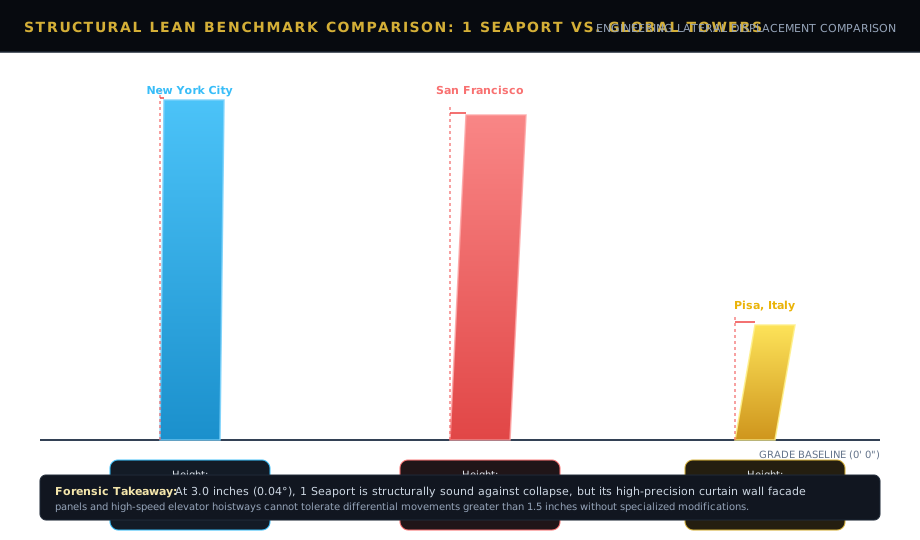
At first glance, lay observers assume San Francisco’s 29-inch tilt is ten times worse than New York’s 3-inch lean. However, from a structural forensics perspective, New York’s 3-inch tilt proved far more lethal to the building's completion:
- Millennium Tower (Occupied Concrete Frame): Millennium Tower completed construction in 2009 and was 100% occupied before its settlement came to light in 2016. Because the tower utilized a heavy cast-in-place concrete moment frame with standard window assemblies, the building settled as a relatively rigid structural box. While internal plumbing lines, elevator guide rails, and golf balls on penthouse floors rolled noticeably, the exterior facade panels remained intact.
- 1 Seaport (Mid-Construction Curtain Wall Racking): 1 Seaport tilted while structural concrete was still being poured and before the exterior curtain wall was installed. Hill West’s design relied on custom, floor-to-ceiling unitized glass curtain wall panels engineered by Italian specialists. When the building tilted 3 inches, the rectangular concrete slab edges racked into parallelograms. Glass panels could no longer be hung without severe inter-panel shear stress, causing construction to immediately freeze.
4. Visual Engineering Cross-Section & Tilt Scale
The technical infographic below contrasts the architectural scale, subsurface foundation depth, recorded lateral deflection, and remediation status of both high-rises:
5. Remediation Engineering: The $100M Perimeter Pile Fix
The most illuminating comparison lies in how San Francisco solved its engineering crisis versus New York’s inability to do so. In San Francisco, structural engineer Ronald Hamburger of Simpson Gumpertz & Heger (SGH) devised an audacious $100 million engineering solution known as the Perimeter Pile Upgrade.
Instead of attempting to jack up the entire building from beneath its core, the SGH team drilled 18 high-capacity steel-cased concrete piles, each 24 inches in diameter, along the northern and western perimeter sidewalks (Mission and Fremont streets). These piles were driven down over 250 feet into Franciscan bedrock. A new reinforced concrete collar was then cast to tie the perimeter piles directly to the building’s original mat foundation.
Hydraulic jacks were installed on each pile head to transfer approximately 18 million pounds (500 tons per pile) of the building’s dead load off the compressible Colma sand and directly onto the new bedrock piles. By relieving pressure on the sinking northwest corner while allowing the southeast corner to settle naturally, the engineering team successfully halted settlement and recovered nearly two inches of tilt.
At 1 Seaport, an analogous remediation—drilling 140+ micropiles through the existing mat slab into Manhattan Schist bedrock at 135+ feet—was proposed. However, because 1 Seaport was uncompleted and empty, no capitalized homeowner association existed to demand a fix, and no public transit authority (such as SF's Transbay Joint Powers Authority) was available to contribute settlement funding.
6. Legal & Financial Resolutions: Global Settlement vs. Impasse
The diverging outcomes reflect the legal environments of California and New York construction jurisprudence:
- San Francisco (Global Multiparty Settlement): In 2020, retired California Superior Court Judge Jerome Horn mediated an all-encompassing confidential global settlement. Developer Millennium Partners, the Transbay Joint Powers Authority, neighboring developers, and the condominium owners agreed to pool over $100 million into an escrow trust dedicated entirely to executing the SGH perimeter pile retrofit, resolving dozens of cross-claims in a single stroke.
- New York (Fragmented Foreclosure & Inaction): In New York, the dispute devolved into binary litigation: general contractor Pizzarotti walked off the job, developer Fortis defaulted on its construction loan, Bank Leumi foreclosed, and the New York Attorney General refunded buyer deposits. With no unified ownership group or occupied resident body, 1 Seaport fell into the purgatory of real estate insolvency.
7. Future Lessons for Supertall Geotechnical Building Codes
The combined fallout from Millennium Tower and 1 Seaport has permanently reshaped American high-rise building codes. The New York City Department of Buildings enacted rigorous amendments to Chapter 18 of the NYC Building Code, mandating peer-reviewed geotechnical investigations and establishing that any building exceeding 40 stories along historic waterfront landfill must anchor deep foundation elements directly into sound bedrock.
Similarly, San Francisco instituted mandatory independent structural and geotechnical peer reviews for all buildings taller than 240 feet. The era of supertall friction piles and cost-saving soil jet grouting along marine waterfronts is officially over. For structural engineers and real estate developers alike, 161 Maiden Lane and 301 Mission Street stand as permanent cautionary monuments: no matter how luxurious the architectural vision above, a skyscraper is only as stable as the bedrock beneath it.
Julian Vance
AuthorSenior Architectural Historian & Civil Engineer
Julian Vance is a Senior Architectural Historian and Civil Engineer specializing in supertall skyscraper engineering, deep geotechnical foundations, and comparative forensic analysis.
Frequently Asked Questions
Which skyscraper leaned more: Millennium Tower or 1 Seaport? +
How was San Francisco's Millennium Tower stabilized? +
Can the same perimeter pile fix be used on 1 Seaport in Manhattan? +
What caused Millennium Tower to sink and lean? +
Are residents currently living in Millennium Tower and 1 Seaport? +
Related Architectural Dossiers
161 Maiden Lane Soil Failure: Why 1 Seaport Tilted 3 Inches
Explore our in-depth architectural and structural analysis of 161 Maiden Lane Soil Failure: Why 1 Seaport Tilted 3 Inches.
161 Maiden Lane Lawsuit Updates: Pizzarotti vs. Fortis Legal Battle
Explore our in-depth architectural and structural analysis of 161 Maiden Lane Lawsuit Updates: Pizzarotti vs. Fortis Legal Battle.
Manhattan’s Hidden Geology: Bedrock Depths & Historic Wharves
Explore our in-depth architectural and structural analysis of Manhattan’s Hidden Geology: Bedrock Depths & Historic Wharves.
1 Manhattan West: Engineering Supertall Structural Cores on Bedrock
Explore our in-depth architectural and structural analysis of 1 Manhattan West: Engineering Supertall Structural Cores on Bedrock.